

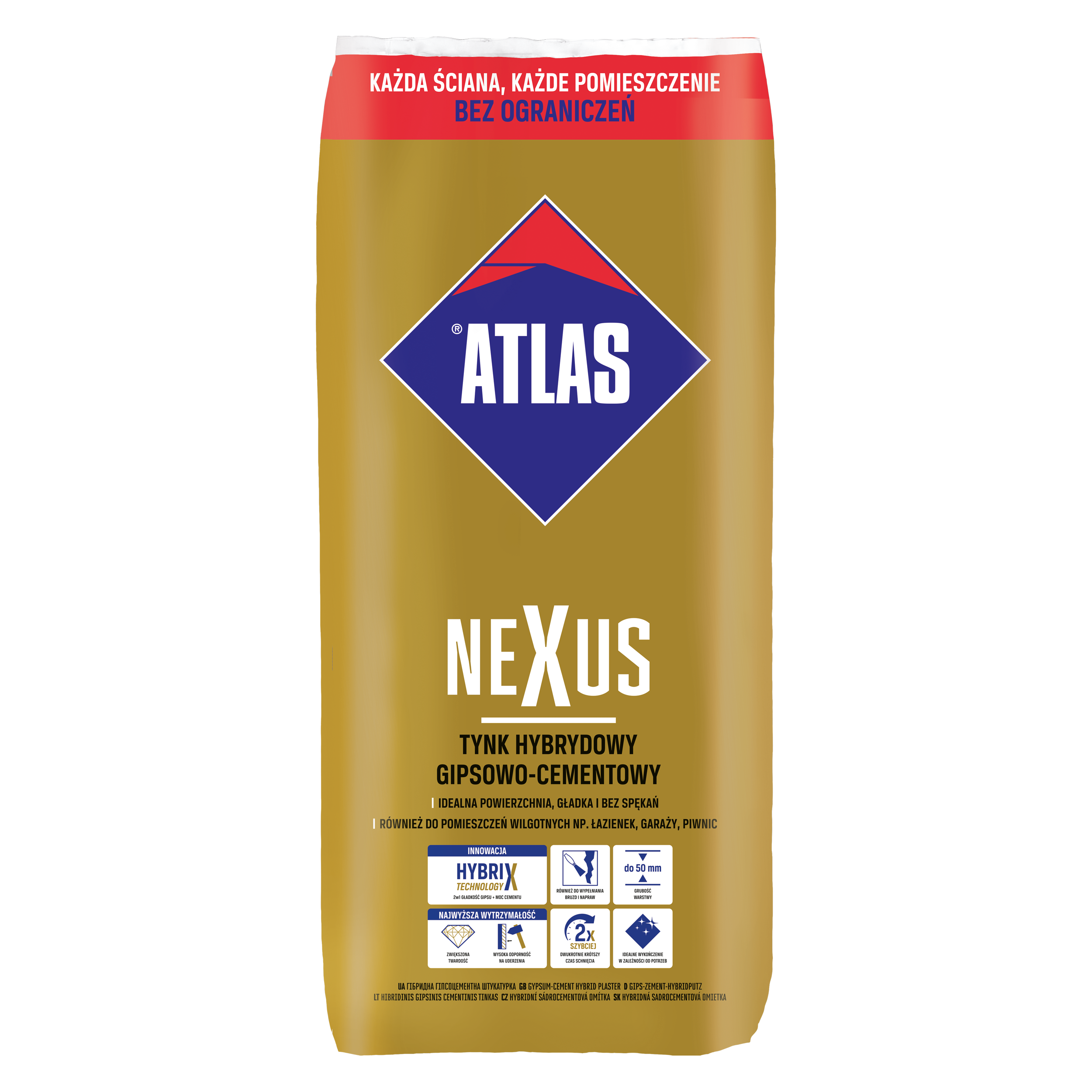
ATLAS NEXUS
hybrid gypsum-cement plaster
- high resistance to impact and scratches
- perfect surface, smooth and crack-free
- highest strength class (≥7 MPa)
- hardness 8 times higher than standard requirements (>20 MPa)
- also suitable for damp rooms, e.g. bathrooms, garages, basements
- ideal substrate for skim coats, wallpaper, paint and decorative finishes
- versatile – from the basement to the roof
- for full-surface plastering, filling gaps, filling grooves, and spot repairs to plasterwork, e.g. reveals after replacing window frames
- fast setting time
– filling gaps and repairing existing plaster,
– fixing installation boxes,
– filling installation grooves,
– finishing door and window reveals during renovation work.

Hybrix TECHNOLOGY is an advanced technology combining previously
incompatible mineral binders – gypsum and cement. This unique combination of
gypsum and cement makes it possible to obtain a new-generation plaster that
combines the smoothness and excellent application properties of gypsum-based
compounds with the strength and durability of cement. The result is a product
with significantly superior working and performance characteristics, designed
for demanding interior applications.
– exceeds the required hardness by as much as 8 times (2.5 MPa) compared to the requirements for the highest class of gypsum plasters (B7).
Excellent workability and easy application.
Wide range of mixing water, tailored to specific applications – consistency can be adjusted according to the contractor’s needs and individual preferences.
Single-layer application without a scratch coat – substrate preparation consists solely of priming, which shortens the process.
Single-stage
mixing – shorter mixing cycle, with no downtime or
re-mixing.
A perfectly smooth surface – can also serve as the final coat,
faithfully reproducing the appearance of formwork concrete.
Increased hardness and high impact resistance.
Very high strength – recommended for the direct installation
of ceramic and stone claddings, as well as plaster mouldings.
Approximately 60% higher adhesion to the substrate
than traditional cement plasters and up to 500% higher than gypsum plasters – recommended for large-format tiles
No
shrinkage – no micro-cracks
during setting, unlike cement-lime plasters.
The recommended
maximum thickness of a single coat of plaster should be 40 mm, and 50 mm in
areas where the substrate is uneven or where the surface needs to be levelled. The
minimum thickness of the applied layer is 5 mm.
Reduced
drying time:
– up to
2 days at a thickness of 2 cm,
– 1
day for a thickness of 1 cm,
(data
applies to tile bonding – see Table 2).